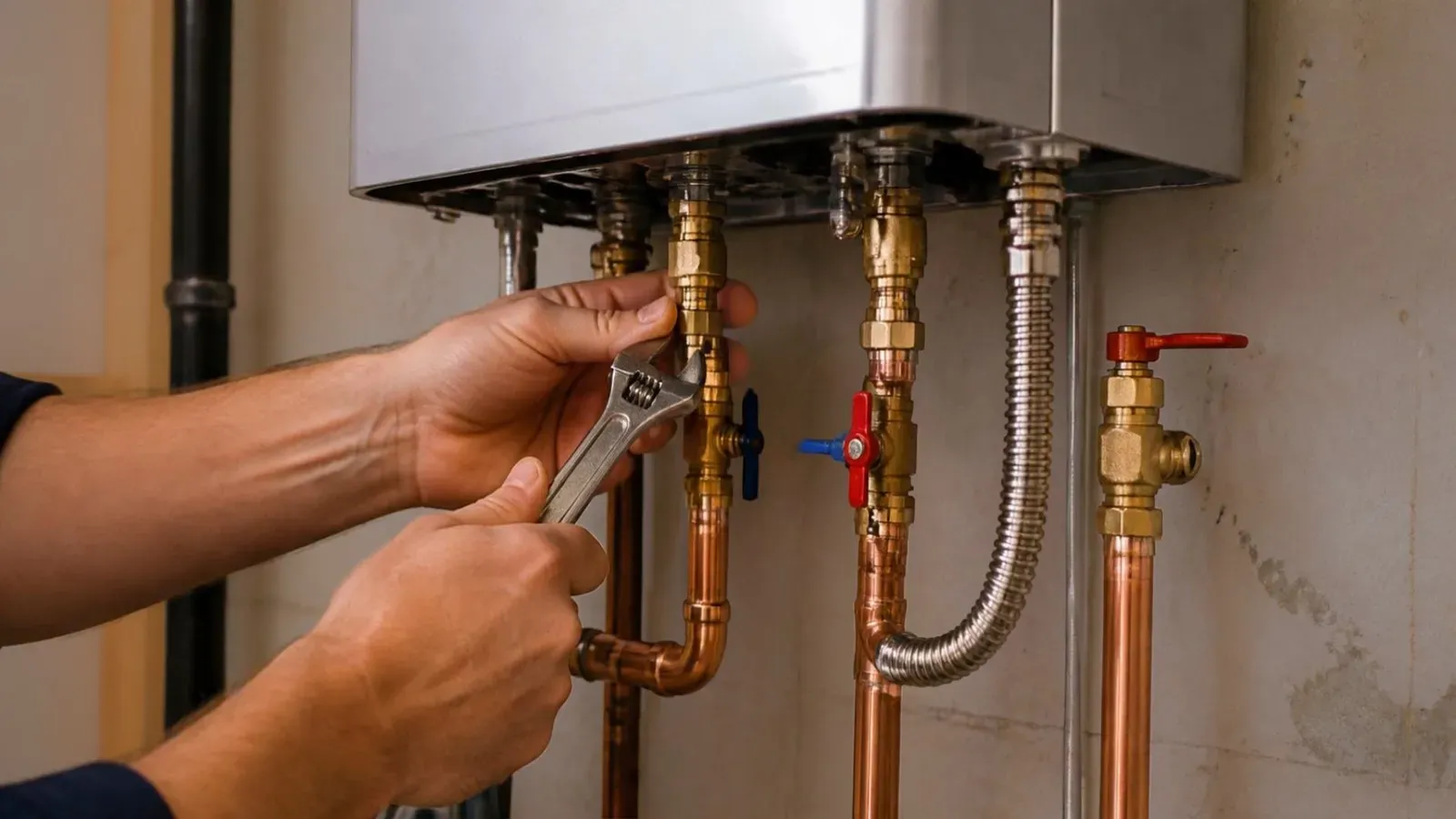
Labor factors and why each one moves the price.
Read the table as a checklist for your own cellar. If three or four rows describe your setup, expect the labor portion of the quote to be on the larger side.
| Factor. | What it means on the job. | Effect on labor. |
|---|---|---|
| Location of the heater. | Basement, closet, attic or crawl space. | Tight or distant spots take more time and more hands. |
| Like for like swap. | Same fuel, same size, same connections. | Usually the shortest job. |
| Fuel change. | Gas to electric or the reverse. | New lines, a new circuit or a gas run add steps. |
| Venting. | Flue condition, length and routing. | Old or damaged venting may need rework. |
| Tank to tankless. | Different gas supply, venting and water lines. | A larger project with more trades involved. |
| Removal of the old unit. | Draining, carrying out and hauling away. | Stairs and weight add time. |
The same tank, two different jobs.
A heater standing in an open cellar with a clean flue and good shutoff valves is a routine swap. The old tank is drained, disconnected and carried out, and the new one is set, connected and tested. A technician can often finish in a part of a day.
Move that same tank into a closet behind a narrow door, add corroded unions and a flue that no longer matches the new unit, and the hours change. None of that is padding. It is real work that has to be done before the heater can run safely.
What to have ready before the technician arrives.
- Clear a path from the stairs to the heater, including the area around the tank itself.
- Find the nameplate on the side of the tank and photograph the model, the fuel type and the capacity.
- Locate the shutoff valves for the water and the fuel, and make sure you can reach them.
- Note how many people use hot water and whether showers run at the same time.
- Tell us about past trouble such as low pressure, rusty water or a relief valve that has dripped.
Every minute spent moving boxes or hunting for a valve is a minute of labor. A prepared house is usually a faster house.
Want the price in writing?
Tell us what you have and we will explain the labor line by line before any work starts.
Hidden items that show up on the quote.
Some line items surprise people because they sit out of sight. An expansion tank, a discharge pipe for the relief valve, new shutoff valves and a corrected gas connector are common examples. Older setups often lack one or more of these.
Ask the plumber to list each item and say whether it is required or optional. A good quote separates the heater, the labor, the parts and any permit work. If you want to see how a full job is handled, read about water heater installation or the faster path of water heater replacement.
Tank versus tankless: how the labor differs.
Neither choice is wrong. The right one depends on your household and your basement. Our page on the tankless water heater option explains what that route involves.
Standard tank.
- Usually reuses the existing water and fuel lines.
- Venting is often a straight swap when the flue is sound.
- Fewer trades and fewer visits in most homes.
Tankless.
- May need a larger gas line and new venting.
- Wall mounting and service valves add steps.
- Often a bigger project that suits planned upgrades.
Garfield cellars, permits and your water.
Many older houses in Garfield have the heater in a basement, so stairs, headroom and the old flue shape the labor. Measure the stair width and the ceiling height near the tank and tell the plumber, because that tells them how the old unit will come out.
The City of Garfield building department is at 111 Outwater Lane, and its page lists plumbing inspections on Mondays and Wednesdays in the late morning. Permit rules vary, so confirm with the building department before you pick a date.
The 2018 City of Garfield water quality report marks hardness as above the recommended range and says hardness scales pipes. Ask the plumber about draining the new tank on a yearly schedule, so scale does not shorten its life.
How to compare two quotes fairly.
Match the scope.
Check that both quotes cover the same fuel, size, venting and removal of the old unit.
Look at the parts line.
Confirm which valves, connectors and the expansion tank are included in each.
Ask about permits.
Find out who pulls the permit and who books the inspection.
Verify the plumber.
Look the license up through the Division of Consumer Affairs before you sign.
Why the lowest quote is not always the lowest cost.
A quote that leaves out the expansion tank or the discharge pipe may look cheaper today. Those items often appear later as add-ons, or the work gets skipped. Ask for a written price before work starts, and make sure it names every part of the job.
We also serve neighbors in Lodi and Wallington, and the same factors apply there. You can reach us on (973) 488-5410 to talk through your setup.
Questions homeowners ask us.
Labor covers draining and removing the old unit, setting the new heater, connecting water, fuel and venting, and testing for leaks and safe operation. Parts such as valves and connectors may be listed separately. Ask for each line in writing.
Access, venting, fuel type and the condition of existing connections change the hours and the skills needed. A simple swap in an open cellar is a different job from a conversion in a tight closet.
Permit rules vary by town and by the type of work. Confirm with the building department before the job, and ask your plumber who handles the paperwork.
Often yes. Tankless units may need a bigger gas supply, new venting and wall mounting. A technician needs to see the space before giving a firm price.
It can. Many older houses here have the heater in a cellar, so stair width, headroom and the flue route all affect how the old unit comes out and the new one goes in. Tell the plumber about those limits up front.
New Jersey plumbing work must be done by a licensed master plumber or people working under one. You can look up a plumber through the Division of Consumer Affairs before signing.