Tankless water heaters in Garfield homes.
A tankless heater fires only when a tap opens, so there is no standing tank to leak or run out. That suits a small cellar and a busy household. It also puts more demand on the gas line, the venting and the water quality, which is where problems begin.
Garfield is a city of 2.19 square miles with older housing and a high share of multi family buildings. A tankless unit in a two family house has to serve both floors, so flow rate and gas capacity are not details to skip. According to the City of Garfield's 2018 water quality report, hardness is above the recommended range, so a tankless heat exchanger collects scale faster here than a soft water manual suggests.
Flushing and descaling: the service most owners skip.
Hard water leaves calcium inside the heat exchanger. Over months it narrows the passages, cuts flow and triggers error codes for overheating or low flow. Manufacturers call for periodic flushing, and in hard water that means more often than the minimum.
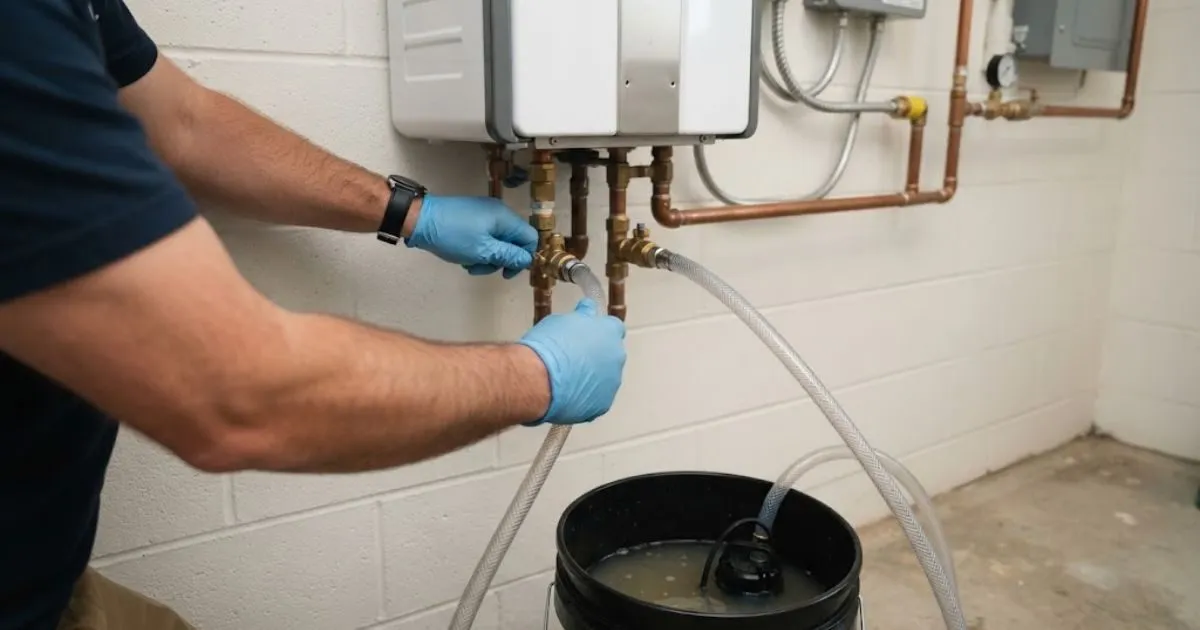
We isolate the unit with service valves, circulate a descaling solution through the heat exchanger, rinse and test. If there are no service valves, we add them, because without valves a proper flush is nearly impossible. The City of Garfield's 2018 water quality report notes that hardness is above the recommended range and that it scales pipes, which is why we treat flushing as maintenance and not an add on.
Signs your tankless heater needs attention.
Error codes.
Codes for ignition, flame failure, exhaust or flow point to different parts of the system. Tell us the code and the model.
Water goes lukewarm.
Scale or a failing flow sensor can limit the burner. A flush often restores output.
Hot and cold surges.
Mixing valve problems, scale and low flow can create a cold sandwich effect.
Short cycling.
The unit starts and stops quickly because flow is too low to hold the burner on.
Noise or odor.
Whistling, kettle sounds or exhaust smells call for a prompt check.
No hot water.
A failed igniter, flame sensor, fan or gas supply problem can shut the unit down. For true failures see our water heater repair page.
Tankless service, matched to the need.
| What you want. | What we do. | When it makes sense. |
|---|---|---|
| Annual maintenance. | Flush, clean the inlet filter, test the combustion and venting. | Every year in hard water, even if nothing seems wrong. |
| Error code repair. | Read the code, test the part, replace the failed component. | As soon as the code appears. |
| New installation. | Size the gas line, vent through approved materials, add service valves. | Planned remodels and replacements. |
| Replacement of a tank. | Remove the tank, rework supply and vent lines, install the unit. | When you are ready for on demand heat. |
What a tankless installation involves.
Load calculation.
We add up the flow the household needs at its busiest and match it to a unit.
Gas and vent review.
Gas pipe size and vent path are checked against the manufacturer's requirements.
Install.
We mount the unit, set the supply and venting, add service valves and connect a condensate drain where required.
Commissioning.
We test combustion, flow and temperature and walk you through the controls.
Tankless is not always the right move.
Some houses are better served by a good tank. If the gas line is undersized, the flue path is awkward or you do not want the maintenance routine, a new tank can be the simpler answer. We would rather talk you out of a poor fit than sell it.
If you are comparing options, our pages on water heater replacement and water heater installation explain how those projects differ.
What affects a tankless quote.
After a short review, you get one price for the whole job. A flush on its own is quoted separately.
Questions homeowners ask us.
In hard water areas most manufacturers and installers recommend at least once a year. Garfield's own water quality report flags hardness above the recommended range.
A code that means no hot water is urgent if the weather is cold or small children live in the home. Our emergency line is open 24/7 and a dispatcher can talk you through safe checks.
It can if the unit and gas line are sized for the peak load. Sometimes two smaller units are better than one large one.
Gas units do, and it must follow the manufacturer's requirements. Electric units do not vent.
Usually. The gas line, vent path and water supply are reviewed first, and some conversions need upgrades.
We work on the major brands sold in New Jersey. Tell us the make and model on the call.
Written by the Garfield Express Plumbing team. Updated October 16, 2026.