Hose bib or frost-proof sillcock? Check before you buy parts.
A plain hose bib is a short faucet that screws into a pipe stub right at the wall. A frost-proof sillcock looks similar from the yard, but it has a long stem that reaches several inches back into the heated part of the house. The valve seat sits inside, so the pipe outside the seat can drain and stay dry.
Look at the faucet body from the side. A long barrel that tilts slightly downward toward the yard is the sign of a frost-proof model. Buying the wrong washer or stem is the most common repair mistake, so take the old part to the store with you. According to the State Board of Examiners of Master Plumbers, work that opens a supply line must be done by a licensed master plumber or someone working under one, so ask to see a license before you agree to a price.
Where the water shows up and what it usually means.
Run the faucet for a minute and watch each spot in the table. The location of the first drop tells you more than the amount of water does.
| What you see. | Likely cause. | First move. |
|---|---|---|
| Drip from the spout with the handle closed. | Worn washer or a damaged valve seat. | Shut off the supply, then replace the washer. |
| Water around the handle when the faucet is on. | Loose or worn packing nut or packing. | Snug the packing nut gently, then replace the packing if it persists. |
| Drip only when a hose is attached. | Failed hose washer or a bad vacuum breaker. | Replace the hose washer and inspect the breaker. |
| Handle spins with no resistance. | Stripped or broken stem. | Replace the stem or the whole faucet. |
| Wet wall, ceiling or cellar after a cold snap. | Pipe split behind the faucet. | Close the interior shutoff and call a plumber. |
Fix a dripping outside faucet, step by step.
Shut off the supply.
Find the interior shutoff for that line, usually in the cellar near the wall where the faucet sits. Close it, then open the outside faucet to drain what is left.
Remove the handle.
Take out the handle screw and lift the handle off. Loosen the packing nut behind it with an adjustable wrench.
Pull the stem.
Unscrew the stem and slide it out. On a frost-proof model it is a long rod, so pull it straight back to avoid bending it.
Replace the washer and packing.
Swap the rubber washer at the tip and the packing around the stem. Match the old parts exactly, and clean any grit off the seat.
Reassemble and test.
Put everything back, open the interior valve slowly and check the spout and the handle for drips. Tighten the packing nut only as far as needed to stop a handle leak.
Stop if the stem will not budge, if the nut starts to round off or if water leaks from the pipe inside the wall. Forcing a stuck part can snap the pipe, and a small repair becomes a bigger one.
Water running inside the wall?
Close the interior shutoff for that line and call. The emergency line answers all night.
Winter shutoff routine before the first hard freeze.
- Disconnect every hose. A hose left on traps water in the faucet and can defeat the frost-proof design.
- Close the interior shutoff for the outside line if you have one, then open the outside faucet to drain it.
- Leave the outside faucet open a little through the winter so trapped water has room to expand without cracking anything.
- Check the tilt. A frost-proof sillcock should slope slightly down toward the yard so it drains fully.
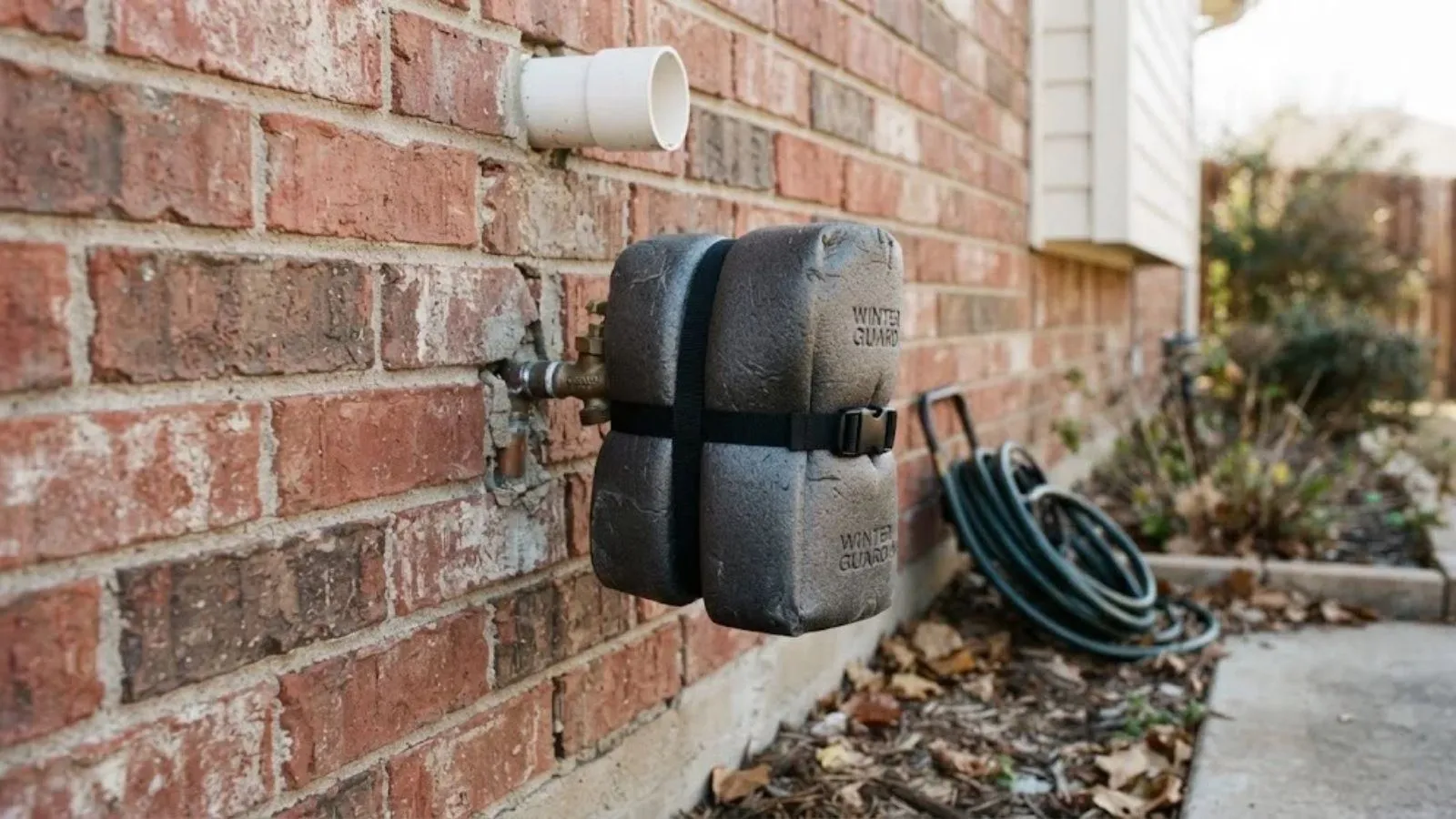
- Cover a plain hose bib with an insulated faucet cover if there is no way to shut it off from the inside.
What freezing really does to the pipe.
Water expands as it turns to ice, and the pipe is the weak point. The split usually forms just behind the faucet, where water sat trapped. You may see nothing until the thaw, when a faucet that looked fine suddenly sprays inside the wall.
After a hard freeze, open the faucet and watch the stream. A weak flow, a hiss or a damp patch on the inside wall means you should close the interior shutoff. A wet ceiling below the faucet is a job for leak detection, and an active spray is a burst pipe repair call.
Garfield cellars, older houses and outside lines.
Garfield has many older houses, and plenty of them feed the outside faucet from a shutoff tucked into a cellar ceiling. Take ten minutes this fall to walk the basement, find each outside line and label its valve, so nobody is hunting in the dark when a pipe splits.
In a two or three family house, ask who controls the outside faucet before you shut anything off. Replacing the faucet body or the pipe behind it is plumbing work, and confirm with the building department at 111 Outwater Lane whether your job needs a permit. Under New Jersey rules, that work belongs to a licensed master plumber or people working under one.
Repair, replace or hand it off.
A new washer or packing is a fair weekend job. If the faucet is corroded, the stem is seized or you want to swap a hose bib for a frost-proof model, our faucet repair team handles it, and larger changes fall under plumbing installation. Ask for a written price before work starts.
We serve neighbors in Lodi and Wallington the same way. Tell the dispatcher what type of faucet you have and where the water shows up, and the visit goes faster.
Questions homeowners ask us.
The hose washer inside the coupling may be worn, or the vacuum breaker on the spout may have failed. Try a new hose washer first. If the drip stays, the breaker needs replacing.
Yes, you still need to disconnect the hose. A hose left on holds water in the barrel, and the faucet cannot drain. Closing the interior shutoff, when you have one, adds another layer of protection.
Often yes. Shut off the supply, snug the packing nut a little and test again. If it still leaks, replace the packing around the stem.
Look for a weak stream, a hissing sound, or dampness on the inside wall or the cellar ceiling after a cold snap. Water that appears only when the faucet is open often points to a split behind it.
Check the cellar ceiling or the wall nearest the outside faucet. Many older Garfield houses have a small valve on the line, sometimes with a bleed cap. If you cannot find one, ask a plumber to add one.
Call when the stem will not move, when the pipe inside the wall is wet or when you have no shutoff. A forced repair on a seized part can turn a drip into a flood.