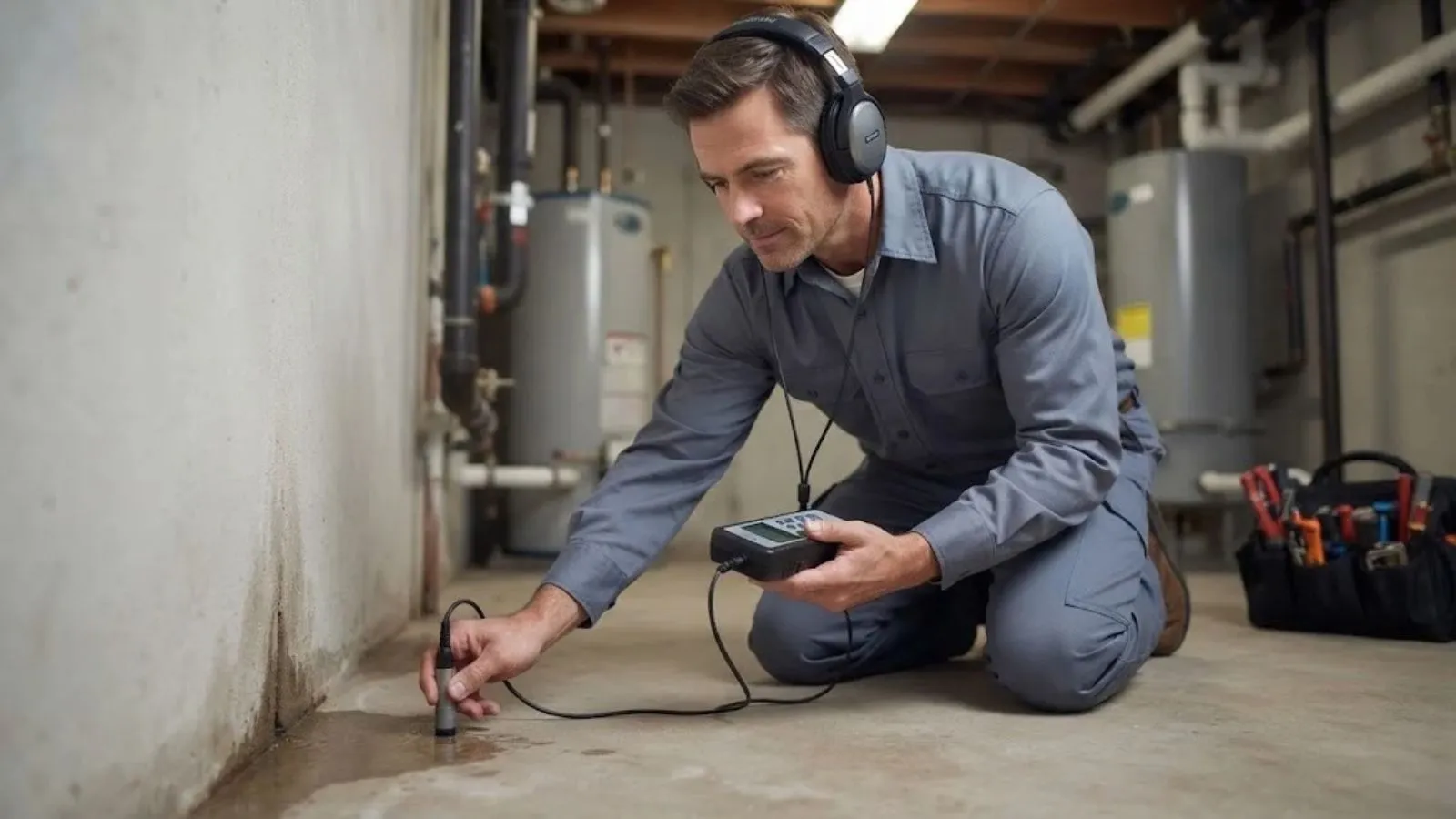
Finding the leak without opening every wall.
Leak detection is a process of elimination. We confirm there is a leak, work out whether it is on the supply or the drain side, then narrow it to a zone and a spot. Each step costs less than guessing and cutting drywall.
In older Garfield homes, pipes run through plaster walls, under cellar floors and across crawlspaces. A leak may show up in a room far from where it starts, and water follows framing and conduit in unexpected ways. According to the State Board of Examiners of Master Plumbers, any repair made after a leak is found must be done by a licensed master plumber or someone working under one, so ask to see a license before you agree to a price.
When a leak is an emergency.
- Water is spreading across a floor, down a wall or through a ceiling.
- The meter keeps turning with every fixture off, and the wet spot is growing.
- You hear running water in a wall that no one is using.
- A wall or floor feels warm over a slab, which can mean a hot water line leak.
- Water is near the electrical panel or a lit outlet. Stay away, and shut off the main valve.
How we find a hidden leak.
Meter test.
We shut off every fixture and watch the meter. Movement means water is escaping somewhere.
Isolate.
Shutoffs and pressure tests separate the hot line, the cold line and the service pipe from the street.
Pinpoint.
Acoustic listening devices, thermal imaging and moisture meters narrow the leak to a zone.
Confirm and report.
You get the location, the likely cause and the repair options, before any wall is cut.
Water meter and high bill leaks.
A bill that jumps with no change in how many people live in the house is often a hidden leak, and the cause is usually a toilet flapper that does not seat, a running irrigation line or a pipe failing underground. You can check your own meter in two minutes.
Turn every fixture off, note the meter reading and look again after fifteen minutes with nothing running. If the dial or the low flow indicator moves, water is escaping. Call us and tell us what you saw, and we will start from there.
What each tool is good at.
| Tool. | Finds. | Limits. |
|---|---|---|
| Meter and pressure test. | Whether a leak exists and which line. | Does not give a location. |
| Acoustic listening. | Pressurized leaks in metal and plastic pipe. | Quiet leaks and loud surroundings can mask the sound. |
| Thermal imaging. | Warm hot water leaks and moisture patterns. | Shows temperature, not water, so results need confirmation. |
| Moisture meter. | Wet materials behind surfaces. | Surface readings only. |
| Camera. | Drain line breaks and leaks from the inside. | Cannot see inside a supply pipe. |
Water where it should not be?
Call the emergency line. A dispatcher will help you stop the flow and send a technician.
Under-house and crawlspace leaks.
Crawlspaces and low cellars hide leaks in supply and drain pipes. Water can sit under a floor for weeks, rotting joists and feeding mold before you notice a damp smell or a springy floor. If you suspect a leak under the house, stay out of standing water and do not crawl in if the electric lines are wet.
A leak under a slab is a different problem. Hot water lines in a slab can warm the floor, and cold lines can leave a damp patch or a hissing sound. We locate the leak first, then discuss going through the slab or rerouting the line. See repiping when failures keep happening.
Ceiling, wall, yard and irrigation leaks.
A stain on a ceiling usually means a supply or drain pipe above it, or a failed seal at a tub or shower. Water travels along joists before it shows, so the stain is rarely under the leak. We trace it back with a moisture meter before any drywall is cut.
Outdoors, a soggy patch near the meter box, a sprinkler zone that never dries or a pool that keeps losing water all point to a line under the ground. Tell us which fixtures and zones are involved. Pool and spa leaks follow the same method, with one extra step to test the equipment lines.
Garfield water and why it matters.
The City of Garfield's 2018 water quality report notes that hardness is above the recommended range and says that hardness scales pipes. Scale roughens the inside of copper and galvanized pipe, which can speed up pinhole failures at elbows and joints.
Many Garfield houses still have galvanized steel or older copper, and pinholes appear in clusters. Finding one is a sign to ask how the rest of the line looks, not a reason to panic.
What affects the price of leak detection.
We tell you the price of the search before we start. If we find the leak, repair options come with their own price.
Many homeowner policies cover sudden water damage but not the cost of finding the source. Ask your agent first and keep the detection report.
Related work.
A found leak often turns into a pipe repair. For a failed section, see burst pipe repair. For a leak on the line from the street, see water service line repair. We also help in Wallington and Lodi.
Questions homeowners ask us.
Yes. The emergency line is open 24/7. Shut off the main valve if water is spreading, and a dispatcher will explain what else to do while a technician is on the way.
A rising water bill, a meter that moves with everything off, damp spots, warm floor patches or the sound of running water are common signs.
In most cases yes. We use meter tests, listening devices and thermal tools to narrow the location before anything is cut.
Turn off every fixture, write down the reading and check again after fifteen minutes. Movement means water is escaping.
Policies vary. Some cover damage but not the search. Ask your agent and keep any report we provide.
We locate it, then discuss repair through the slab or rerouting the line around it.
Written by the Garfield Express Plumbing team. Updated October 16, 2026.