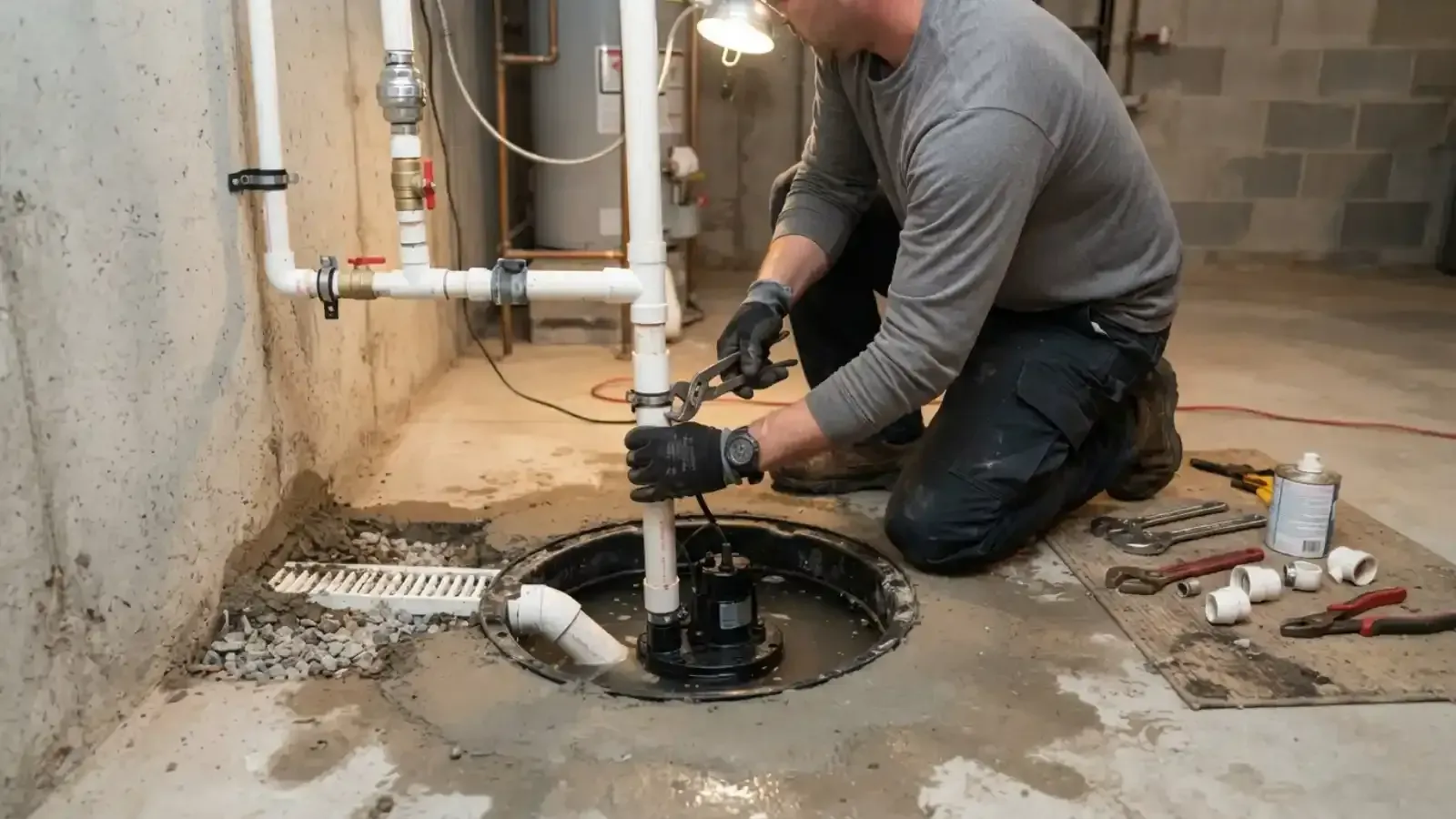
Why a basement in this part of Bergen County needs a pump.
A sump pump does one job. Water collects in a pit below the floor, a float switch senses the level, and the pump pushes the water out of the house before it reaches the slab. Without a pit, groundwater looks for any crack, floor joint or drain it can find.
Many Garfield houses are older and sit close to the Passaic River and the Saddle River. When the ground is saturated after a long rain, the water table rises under the cellar floor. A pit gives that water a place to go that is not your laundry corner. According to National Weather Service records for the Saddle River at Lodi, the gauge reached 13.94 feet in September 1999 against a flood stage of 6 feet, so a pit and pump are worth planning for low basements near the river.
How the install runs from start to finish.
Pick the low spot.
We look for where water already shows up, then place the pit at the lowest corner with room to reach it for service later.
Cut and dig the pit.
The slab is cut with a saw, the concrete is broken out and the soil is dug to the depth the basin needs. Expect dust, noise and a stack of broken concrete.
Set the basin and pump.
A liner goes in with gravel around it, the pump sits on a firm base inside, and the float is checked so it can move freely without touching the wall.
Add the check valve and discharge line.
The valve goes in the pipe just above the pump. The line then runs through the rim joist or wall to the outside.
Seal, test and label.
The slab is patched around the pit, a lid goes on, and we pour water in to watch the pump start, run and shut off cleanly.
Ask for the plan in writing before the saw comes out. It should name the pit location, the pump, the discharge route and who handles the concrete patch.
Submersible or pedestal pump.
For most finished or semi-finished cellars, a submersible is the common pick. A pedestal can make sense in an unfinished space where noise does not matter. Whichever you choose, the switch type, the pit size and the pump power matter more than the brand name on the box.
Submersible pump.
- Sits inside the pit, out of sight.
- Quieter, because the water muffles the motor.
- Handles tighter pits and finished basements.
- Harder to pull out for service.
Pedestal pump.
- Motor sits above the pit on a stand.
- Easier to reach and sometimes cheaper.
- Louder and more visible in the room.
- Needs a narrow pit and a clear overhead space.
What to settle before the pit is cut.
- Where the water comes in. Mark the damp patches and the wall cracks, so the pit sits near the real problem.
- Where the discharge pipe will exit. It needs a route that does not freeze solid or spill toward your neighbor's wall.
- Power. The pump needs its own outlet, and a ground fault protected circuit is the usual setup.
- A battery backup. A storm that floods your cellar often takes the power out too.
- A high water alarm. It costs little and gives you a warning before the floor does.
Water in the cellar right now?
Call the 24/7 line. A dispatcher will tell you what to shut off while a technician is on the way.
The check valve and the discharge route.
The check valve is a one-way gate in the discharge pipe. Without it, the water in the pipe falls back into the pit each time the pump stops, and the pump short-cycles. A good valve also keeps the pump from working harder than it has to.
The discharge line should carry water well away from the foundation, because water dumped beside the wall just returns to the pit. In winter an exposed pipe can freeze, so a short, sloped run with a clean outlet is better than a long flat one. Do not connect the sump discharge to the sanitary sewer. Ask the Garfield building department what it allows before you pick a route.
Battery backup options at a glance.
A battery only lasts as long as its charge, and it ages. Test the backup a few times a year by unplugging the main pump and pouring water into the pit.
| Option. | How it works. | Good fit when. |
|---|---|---|
| Second DC pump on a battery. | A small pump sits beside the main pump and runs on a marine-style battery. | Outages in your area are short and storms are the main threat. |
| Battery backup system with charger. | A control panel watches the main pump and switches over when power fails. | You want an alarm and automatic testing. |
| Water-powered backup. | City water pressure runs a small ejector when the main pump stops. | Only where the water utility allows it and the pressure is steady. |
| Generator circuit. | The sump outlet is wired to a home generator. | You already own a generator and can start it safely. |
Flood history that points back to your cellar.
The National Weather Service gauge on the Saddle River at Lodi records a flood stage of 6 feet. The river crested at 13.94 feet in September 1999 during Hurricane Floyd and at 13.5 feet in August 2011 during Hurricane Irene. If your cellar took on water in either storm, the pump you choose should be sized and backed up for that kind of event.
Garfield also sits along the Passaic River, and the Saddle River forms the boundary with Wallington. For a house on a low block near either river, ask your installer how the discharge will behave when the ground outside is already soaked. Then confirm any permit or inspection with the building department at 111 Outwater Lane.
Who does the work and what shapes the price.
Plumbing work in New Jersey has to be done by a licensed master plumber or people working under one. You can look up any plumber through the Division of Consumer Affairs. The cost depends on slab thickness, pit depth, the length of the discharge run, the pump you pick and how much concrete patching you want.
Ask for a written price before work starts. Our sump pump service page covers installs and replacements, and a persistent damp cellar may also need the basement waterproofing conversation. We also serve Lodi and Wallington, where the same river basin puts basements under the same pressure. Call (973) 488-5410 to book a visit.
Questions homeowners ask us.
A replacement in an existing pit can take a couple of hours. A new pit with a discharge line often takes a full day because of the slab cutting, digging and patching. Your plumber should give you a time frame along with the price.
If the pump protects a finished space or stored belongings, a backup is worth having. Heavy storms are exactly when power fails. A backup pump and a high water alarm are cheap compared with a flooded basement.
Swapping a pump in an existing pit is a reasonable weekend task if you are comfortable with basic plumbing and electrical safety. Cutting the slab, routing the discharge and wiring the outlet are better left to a licensed plumber. A mistake in those steps can flood the cellar or create a shock hazard.
It should end outside, well clear of the foundation, with a slope that carries water away. It should not tie into the sanitary sewer. Ask the Garfield building department what is allowed on your lot.
Not always, but a low lot near either river deserves a closer look at pump power, the discharge route and a backup. Ask the installer to explain how the system will handle a night of heavy rain with saturated ground. Your own cellar's wet history is a useful guide.
Pour a bucket of water into the pit every few months and watch the pump start and stop. Check the discharge outlet outside for blockages. Clean the pit of silt and debris when you see it building up.