Waterproofing begins with where the water enters.
Water gets into a basement in a handful of ways. It comes through cracks in the wall, up through the floor and wall joint, around pipe penetrations, through window wells or from a sewer or drain backup. The fix differs for each, so we find the entry first.
Some Garfield cellars have stone or block foundations that have shifted over a century. Others have poured concrete, and the cracks are small and clean. A flood after a big storm is different from slow seepage after a week of rain, and both tell us something.
Signs of a water problem.
Efflorescence.
White chalky deposits on walls come from water carrying minerals through masonry.
Damp smell.
A musty basement is a damp basement, whether or not you see water.
Peeling paint.
Water behind paint pushes it off the wall.
Water at the wall floor joint.
Hydrostatic pressure pushes water in where wall meets slab.
Rusting at the base of appliances.
Metal at floor level rusts when humidity and seepage are constant.
Past flooding.
A basement that has flooded once in a storm is likely to again.
Interior and exterior approaches.
Interior systems.
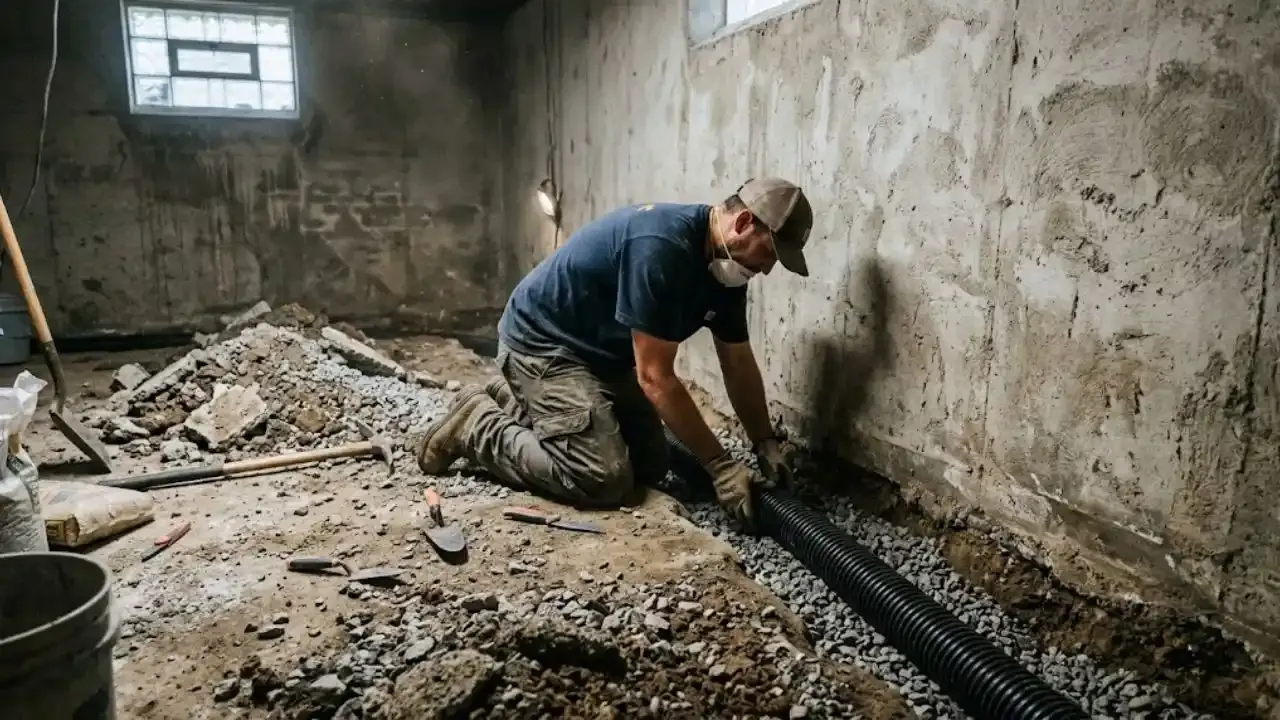
- Perimeter drain channel along the floor edge.
- Sump pit and pump to move water out.
- Less excavation and quicker.
- Manages water that gets in, instead of stopping it outside.
Exterior work.
- Excavation to the footing, membrane and drainage.
- Stops water at the wall.
- Much more disruptive and costly.
- Used where access and conditions allow.
What a Saddle River flood tells a Garfield basement.
When the Saddle River at Lodi crested at 13.94 feet in 1999 and 13.5 feet in 2011, according to National Weather Service records, groundwater rose across the surrounding area, not only along the banks. Basements far from the water can feel it, because a high water table pushes up against the slab and walls.
That is why a drain system and a pump belong together. The drain collects seepage and the pump moves it out. See sump pump service for the pump side of the job.
How a waterproofing project runs.
Inspect.
We check walls, floor, windows, gutters, grading and the existing pump.
Plan.
You see the recommended system, the discharge route and the price in writing.
Install.
Interior drains are cut into the floor edge, the pit is set and the pump is connected.
Test and finish.
We test the system with water, patch the floor and explain maintenance.
Fix the outside first.
Sometimes the cheapest waterproofing is outside the house. Gutters that spill near the foundation, downspouts that discharge at the wall and soil that slopes toward the house all push water into the basement. Extending downspouts and regrading are often worth doing before any interior work.
We tell you when the inside fix is not the only fix. A system that handles seepage but ignores a spilling downspout still has the same cause.
What changes the cost of waterproofing.
You get a written price after the inspection. We explain what is and is not included.
Questions worth asking any waterproofer.
Ask where the water enters and how the contractor knows. Ask what happens to the water after it is collected, because a drain that empties into a pit with no discharge plan solves nothing. Ask what the quote includes for the pump, the backup and the floor patch.
Ask how the system is maintained and what the pump needs each spring. A good answer is specific. A vague one is a reason to get a second opinion, and we are happy to look at a quote you already hold.
Related work.
Plumbing installs such as a basement bath are covered under plumbing installation. We also serve cellars in Wallington and Saddle Brook.
Questions homeowners ask us.
Repeated seepage, flooding after storms, musty smells and white deposits on walls all point to a water problem worth addressing.
A sump pump is one part of a system. Waterproofing includes drains, the pit and pump, and often exterior fixes.
Yes, but finished floors and walls add work. We explain the options before starting.
It manages water that enters. Humidity may still need a dehumidifier.
Gutters, downspouts and grading near the foundation. Fixing them can reduce basement water.
It generally does not cover the cost of preventing future water. Check your policy for flood and sewer backup.
Written by the Garfield Express Plumbing team. Updated October 16, 2026.