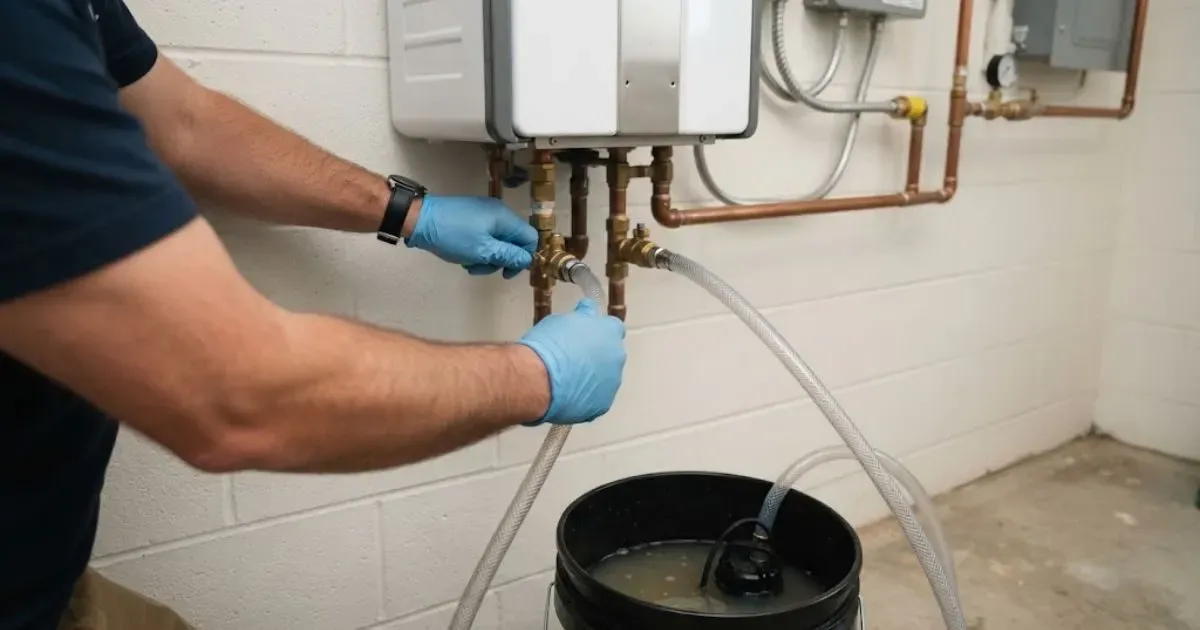
Gather these before you start.
- A small submersible pump rated for pumping liquids.
- Two washing machine style hoses that connect to the service valves.
- A five gallon bucket and about two to three gallons of white vinegar.
- The manual for your model, since drain and flush steps vary by maker.
- Towels and a flashlight for the work area.
Do not use bleach or harsh descalers. They can attack internal parts and create fumes. White vinegar is mild and effective on mineral scale.
Descale with service valves and vinegar.
Power down.
Turn off the electric supply or set the gas control to off, and wait for the unit to cool.
Close the valves.
Shut the cold and hot isolation valves, and close the gas valve if your unit has one at the heater.
Connect the hoses.
Attach one hose from the pump to the cold service port and the other from the hot port back to the bucket.
Add vinegar.
Pour vinegar into the bucket, open the service ports and run the pump so the vinegar circulates through the heat exchanger.
Circulate.
Let it run for about forty five minutes to an hour, longer if the scale is heavy.
Rinse and restore.
Drain the vinegar, flush with clean water, remove the hoses, reopen the valves and check for leaks.
After the rinse, clean the small inlet filter screen if your model has one. Debris there can mimic scale trouble.
Rather have a pro do it?
Tell us the make and age of your unit and we will explain what a service visit involves.
Stop and call a plumber if you see these.
No service valves.
Without isolation valves, flushing is difficult and may risk the unit.
Error codes that return.
A code after cleaning means something besides scale is wrong.
Water at the unit.
A leak at the heat exchanger or fittings needs repair, not a flush.
Gas odor or soot.
Leave the building, call 911 or the gas utility from outside, and do not run the heater.
Rotten egg smell.
That is a gas leak signal, so treat it as an emergency.
Hard water and tankless units in Garfield.
The City of Garfield 2018 water quality report marks hardness as above the recommended range and says hardness scales pipes. A tankless heat exchanger has narrow passages, so even a thin layer of scale can cut flow and trigger error codes. Plan on flushing at least once a year, and test your tap for hardness.
Garfield water is a blend of the city wells and treated Passaic Valley Water Commission supply, and the mix differs by neighborhood. Ask your water utility what reaches your street, and tell your plumber so the schedule fits.
What the symptom may mean.
A table cannot diagnose your unit, but it shows where cleaning helps and where it does not.
| Symptom. | Likely cause. | First step. |
|---|---|---|
| Lukewarm water. | Scale on the heat exchanger. | Descale with vinegar. |
| Flow drops over time. | Clogged inlet screen or scale. | Clean the screen, then flush. |
| Error code after flushing. | Air in the lines or a fault. | Bleed air, then call if it repeats. |
| Water leaking. | Failed seal or heat exchanger. | Shut off water and call. |
| Loud knocking. | Heavy scale or a flow issue. | Flush and recheck. |
How often should you flush.
Most makers suggest a yearly flush, and homes with hard water may need it more often. If you notice a drop in temperature or flow, do not wait for the calendar. Write the date on a tag near the unit so you know when you last did it.
Scale rarely announces itself. The first clue is often a shower that takes longer to warm up, or a unit that cycles on and off more than it used to. Catching that early keeps the cleaning job short and the heat exchanger healthy.
A water softener can slow scale buildup, though it needs its own care. Our page on the tankless water heater explains installation and upkeep, and water heater repair covers failures that a flush cannot fix. According to the City of Garfield's 2018 water quality report, hardness is above the recommended range, so descaling a tankless unit belongs on your yearly calendar.
Mistakes that turn a flush into a repair.
The most common error is skipping the step that closes the isolation valves before the hoses go on. Water then sprays from the open ports, and the unit may be left with air in its lines. Take your time and read the labels on each valve handle.
Another is running the pump dry. Make sure the intake end of the hose stays under the vinegar the whole time. A third is forgetting to reopen the valves afterward, which leaves the unit without water and can set off an error code the moment it fires.
Finally, do not force a stuck valve. Old service valves can seize, and a broken handle turns a one hour chore into a plumber visit. If a valve will not move with steady hand pressure, stop there.
Safety notes before you open anything.
Never work on a gas line or vent. Those jobs belong to a licensed plumber. In New Jersey, plumbing work must be done by a licensed master plumber or people working under one, and you can check a license through the Division of Consumer Affairs.
We serve Garfield and nearby towns such as Lodi and Saddle Brook. You can reach us on (973) 488-5410 if you want a technician to take over.
Questions homeowners ask us.
It is possible but harder, and the risk of leaks rises. A plumber can add isolation valves, which makes every future flush simple.
White vinegar is mild and widely used for descaling. Run it only for the time your manual allows, then rinse well with clean water.
About forty five minutes to an hour is common. Heavy scale may need longer, and your manual may give its own time.
Air can be trapped in the lines, or the unit may have a fault that scale was hiding. Bleed the air, and if the code returns, call a plumber.
The city report marks hardness as above the recommended range, so at least once a year is a sensible start. Test your tap and flush sooner if flow or temperature drops.