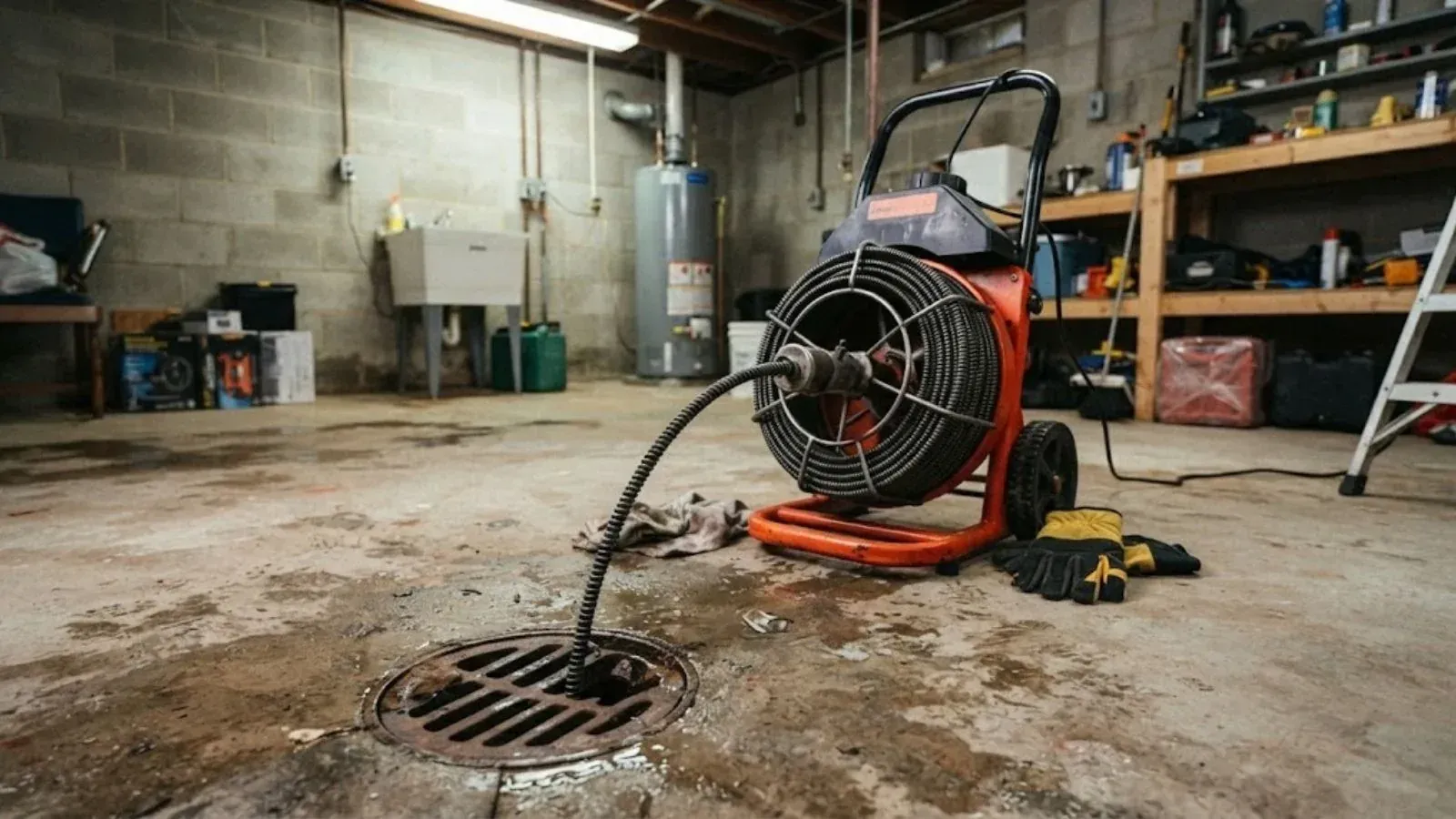
The pipe nobody thinks about.
Every drain in your house empties into one larger pipe, the building drain. It runs under the floor or along the cellar wall, then leaves the house as the sewer lateral and connects to the city sewer. A clog here stops all the fixtures that feed it.
That is why a main line problem looks different from a sink clog. The toilet gurgles when the washer drains, a basement floor drain bubbles, or two bathrooms back up at the same time. Those signs deserve a call, since the water in a blocked main has nowhere to go but up. According to the New Jersey Division of Consumer Affairs, you can look up a plumber's license online before you hire, and we suggest you do that for any contractor who cuts roots out of your main line.
What a main line problem looks like.
Several fixtures slow at once.
A tub in the basement that backs up when someone upstairs flushes is a classic sign.
Gurgling from drains and toilets.
Air is being pushed out through the nearest opening because the water cannot move past the blockage.
Sewage smell in the cellar.
A bad smell near the floor drain can mean the trap is dry, or the line is partly blocked.
Water at the floor drain.
A basement floor drain that fills when the washer runs is a strong warning.
Do not run more water if you see these signs. Shut off the washer, hold off on showers and call for help.
A yearly main line routine you can actually keep.
- Locate the cleanout. It is a capped pipe, often in the basement near the foundation wall or outside near the house. Keep the area around it clear.
- Look at the trees. Large trees and shrubs with thirsty roots near the lateral path are a known cause of main line blockages.
- Note any repeat backups. Write the date and what you were doing. A pattern helps a plumber find the cause.
- Book a camera inspection when you move in, when the line is slow, or before you finish a basement.
- Plan a cleaning if the camera shows grease, scale or fine roots starting to build.
How to match your line to a schedule.
These are planning guides and not rules. A plumber who has seen your camera footage can set the timing for your actual pipe.
| Situation. | Reasonable schedule. | Why. |
|---|---|---|
| Newly purchased older house. | Camera inspection before or soon after closing. | You learn the pipe material, the slope and any damage. |
| Mature trees near the lateral. | Annual cleaning or camera check. | Fine roots return after every cutting. |
| No history of backups. | Camera check every few years. | A baseline lets you spot change. |
| One past backup, cause fixed. | Annual check for the first couple of years. | Confirms the repair holds. |
| Rental or multi-family house. | Annual cleaning. | More fixtures and more grease on the line. |
Main line backing up?
Do not wait for it to spill. Call the 24/7 line and a technician will come out when one is free.
Roots and old pipe: the two big troublemakers.
Tree roots seek water, and a sewer joint is a steady source. A tiny crack lets moisture out, a root finds it and grows in. Over time the root mass narrows the pipe until paper and waste catch on it.
Older clay and cast iron pipe also scale, sag and crack. A low spot, called a belly, holds standing water and waste, which then collects more. Cutting the roots clears the line for a while, but a camera visit tells you whether the pipe still holds up, and our sewer inspection service is built for that.
Cleaning or repair?
The camera footage decides. If the pipe is intact, regular cleaning is enough. If it is broken, cleaning only buys time.
Clean the line.
- Cable or jetting clears roots, grease and scale.
- Fits a sound pipe with a buildup problem.
- Quicker and lower in cost.
- Roots can grow back if the joint is open.
Repair or replace.
- Fits a cracked, offset or collapsed pipe.
- Fits a belly that keeps holding waste.
- Stops the problem at its source.
- Needs more work and often a permit.
Storms, river water and the Garfield sewer.
Garfield sits on the Passaic River, and the Saddle River forms the boundary with Wallington. The National Weather Service gauge at Lodi shows a flood stage of 6 feet, with crests of 13.94 feet in 1999 and 13.5 feet in 2011. In heavy rain, extra water in the ground and in the sewer system can slow a main line that was already marginal, so have it checked before storm season, not after.
Many Garfield houses are older, which often means older pipe. If your cleanout is buried, painted over or missing, ask a plumber to locate or add one. Then confirm any permit for sewer work with the building department at 111 Outwater Lane.
Cold weather and what it does to the line.
Freezing ground shifts old pipe and can open joints that were tight in summer. Grease also hardens faster in a cold sewer, so a line that was marginal in October may clog in January. A late fall camera check or cleaning is a good time to catch both problems.
If you need a cleaning, our sewer line cleaning team can clear the main, and sewer line repair covers a damaged pipe. We also work in Elmwood Park and Saddle Brook. Call (973) 488-5410 to schedule a visit.
Questions homeowners ask us.
It depends on the pipe, the trees and the history of backups. A house with mature trees or an older line may need a yearly cleaning. A clean, newer line may only need a camera look every few years.
A cleanout is a capped access point on the building drain or lateral. It lets a plumber send a cable or a camera into the line without removing a toilet. Knowing where yours is can save time in an emergency.
Yes. Roots are drawn to moisture and can slip through tiny cracks or loose joints. Once inside, they grow into a mat that catches waste and paper.
No. A small camera on a flexible cable is fed through the cleanout and shows the pipe from inside. It gives you a recording and a clear idea of the pipe's condition.
If your house is older or has had a backup, yes. The Saddle River at Lodi has crested well above its 6 foot flood stage, and wet ground adds load to the system. A camera check or cleaning before storm season is cheap peace of mind.
Stop using water, stay out of the standing water and keep children and pets away. Call a plumber right away. Do not use chemical cleaners on a main line backup.