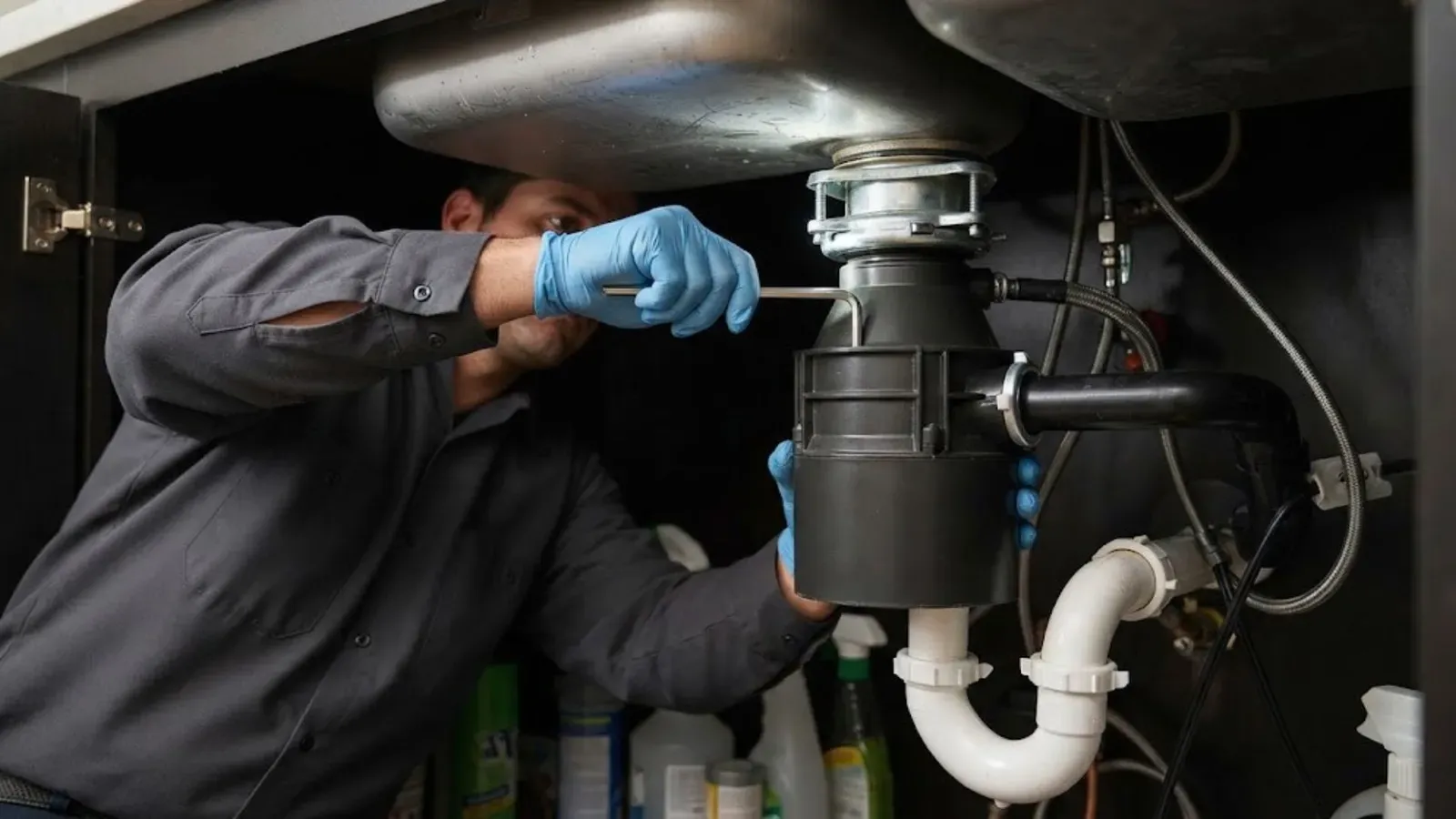
Clear a jam and reset the unit.
Cut the power.
Switch off the wall switch and unplug the unit, or turn off the breaker if it is hard wired.
Look from above.
Use a flashlight to check for a spoon, bone or fruit pit. Remove anything with tongs, never your hand.
Turn the hex wrench.
Insert the wrench into the socket in the center bottom of the unit and work it back and forth until it turns freely.
Press reset.
Push the red button on the bottom of the unit once the motor has cooled.
Test with water.
Run cold water, restore power and switch the disposal on briefly.
If the unit trips again right away, do not keep pressing reset. The motor may be failing.
What the symptom usually means.
Many of these have simple fixes, though a few point to wear that will not go away on its own.
| What you notice. | Likely cause. | What to try. |
|---|---|---|
| Hum with no spin. | Jammed flywheel. | Hex wrench, then reset. |
| Silence when switched on. | Tripped reset or no power. | Reset button, check the outlet. |
| Spins but drains slowly. | Clog past the disposal. | Check the drain line. |
| Water under the sink. | Leaky seal, flange or housing. | Find the source, then repair or replace. |
| Bad odor. | Food residue. | Ice and citrus peels, cold water. |
| Loud grinding. | Foreign object or worn parts. | Inspect, then call if it persists. |
Water pooling under the sink?
Shut the valves under the sink and call us. We will help you find the source.
Finding where the leak comes from.
Dry the cabinet, wipe the unit and tape a sheet of paper towel under it. Run water and watch where the first drop appears. A leak from the top flange points to the sink mounting. A drip at the dishwasher hose or drain pipe points to a loose connection.
A leak from the body of the disposal itself means a cracked housing or failed internal seal. That cannot be fixed with a wrench. If you are not sure, our team can sort out the source, and our garbage disposal page explains the service. According to the City of Garfield's 2018 water quality report, hardness is above the recommended range, so scale can build in the drain behind a disposal.
Garfield kitchens and what goes down the drain.
The City of Garfield 2018 water quality report marks hardness as above the recommended range and says hardness scales pipes. Scale can narrow the drain line past the disposal, so slow draining may not be the disposal at all. Run cold water, and if the sink still backs up, ask us about the line.
Many older houses in Garfield have drain lines that have seen decades of use. A disposal can push grease and scraps into those lines, so keep fats and starchy scraps out. If a clog follows, see our drain cleaning service.
Do not put these down a disposal.
- Grease and oil, which cool and coat the pipes.
- Coffee grounds in large amounts, which pack into sludge.
- Pasta, rice and potato peels, which swell and clog.
- Bones and fruit pits, which jam the flywheel.
- Fibrous scraps such as corn husks and celery strings.
Run cold water for several seconds before and after each use, so scraps move all the way past the trap. A few ice cubes ground up once in a while knock off residue on the grinding parts, and citrus peels freshen the chamber.
Repair or replace the disposal.
Ask for a written price on both options before work starts, so you can compare them side by side.
Repair usually makes sense when.
- The unit jammed once and now runs fine.
- The leak is at a hose, flange or drain connection.
- The motor is quiet and the reset holds.
Replace usually makes sense when.
- The housing leaks from the body.
- The reset trips again and again.
- The grinding parts are worn and noisy.
When the problem is not the disposal.
A disposal that runs fine but leaves the sink full is often a clog downstream. Check the other side of a double sink and the trap under the cabinet. If both sides back up together, the blockage sits farther along the line.
Cold water matters here, because it keeps grease solid so the blades can chop it and the flow can carry it away. Warm water melts fats that then coat the pipe farther down.
A disposal that smells even after cleaning may have residue under the splash guard. Lift the rubber flange and scrub the underside with a brush and dish soap. If the sink also gurgles, the vent or drain line may need attention, and a plumber can scope it.
Wiring, permits and who should do the work.
A disposal runs on household power, so replacing one involves electrical connections as well as plumbing. In New Jersey, plumbing work must be done by a licensed master plumber or people working under one. You can look up a plumber through the Division of Consumer Affairs.
We also serve Lodi and Wallington, and you can reach us on (973) 488-5410 to book a visit.
Questions homeowners ask us.
That sound usually means the flywheel is jammed. Turn off the power, free it with the hex wrench from underneath, wait for the motor to cool and press the reset button.
On most models it is a small red button on the bottom of the unit. If you cannot find it, check the manual or call us.
Chemical cleaners can damage seals and splash back. Use cold water and mechanical methods first, and call a plumber if the clog persists.
Many last for around a decade with care, though use and water quality change that. Frequent resets and rust are signs of age.
It can contribute, since the city report marks hardness as above the recommended range and says hardness scales pipes. If the disposal runs fine and the sink still drains slowly, the line past it may need cleaning.